

Gratitude journaling is one of the simplest yet most transformative habits you can build. It’s not about ignoring what’s hard, rather it’s about learning to notice what’s still good and encompasses hope. By reflecting on small moments of appreciation each day, you begin to shift your focus from what’s missing to what’s already here. In a world that constantly asks for more, gratitude helps you slow down and feel content in the present moment.
This post may contain affiliate links. If you make a purchase through them, I may earn a small commission at no extra cost to you.
Table of Contents
Overview
In this post, we’ll explore how to start gratitude journaling from scratch, even if you’ve never kept a journal before. You’ll learn how to choose the right journal, what to write about, how to stay consistent, and how to make it a natural part of your routine.

Photo by Gabrielle Henderson on Unsplash
Step 1 – Choose Your Journal
Your gratitude journal doesn’t need to be fancy; it just needs to feel inviting. You can use a notebook, a digital app, or even a notes page on your phone. What matters most is that it’s easy to access and enjoyable to use.
If you love handwriting, pick a journal with paper that feels smooth and comfortable. If you prefer typing, digital journals or apps like Gratitude: Self Care Journal or 5 Minute Journal are great choices. The key is to remove resistance; make journaling something you want to return to rather than an obligation you feel you have to force.
If you want something guided you can start off with this 6-Minute Daily Gratitude Journal or if you want something really basic you can start with this Simple Gratitude Journal.
Step 2 – Set a Consistent Time
Consistency matters more than duration. Start by choosing a time that naturally fits your day, for example right after waking up, before bed, or during a quiet break. This helps build momentum and will eventually flow into your natural routine.

Photo by Nathan Dumlao on Unsplash
Morning journaling helps set a positive tone for the day, while evening journaling allows you to reflect on what went well. Some people even keep their journal open on their desk to add notes throughout the day. Find what feels sustainable for you, not what sounds ideal.
Step 3 – Keep It Simple
You don’t need to write paragraphs. Start with a simple structure, like listing three things you’re grateful for each day. These can be big moments (“I got a promotion”) or small ones (“The sunlight through my window this morning”).
Over time, you’ll notice patterns: things, people, or experiences that consistently bring you joy. This awareness gently rewires your mind to look for the good, even in ordinary moments, and the more you notice, the more you’ll receive to experience.
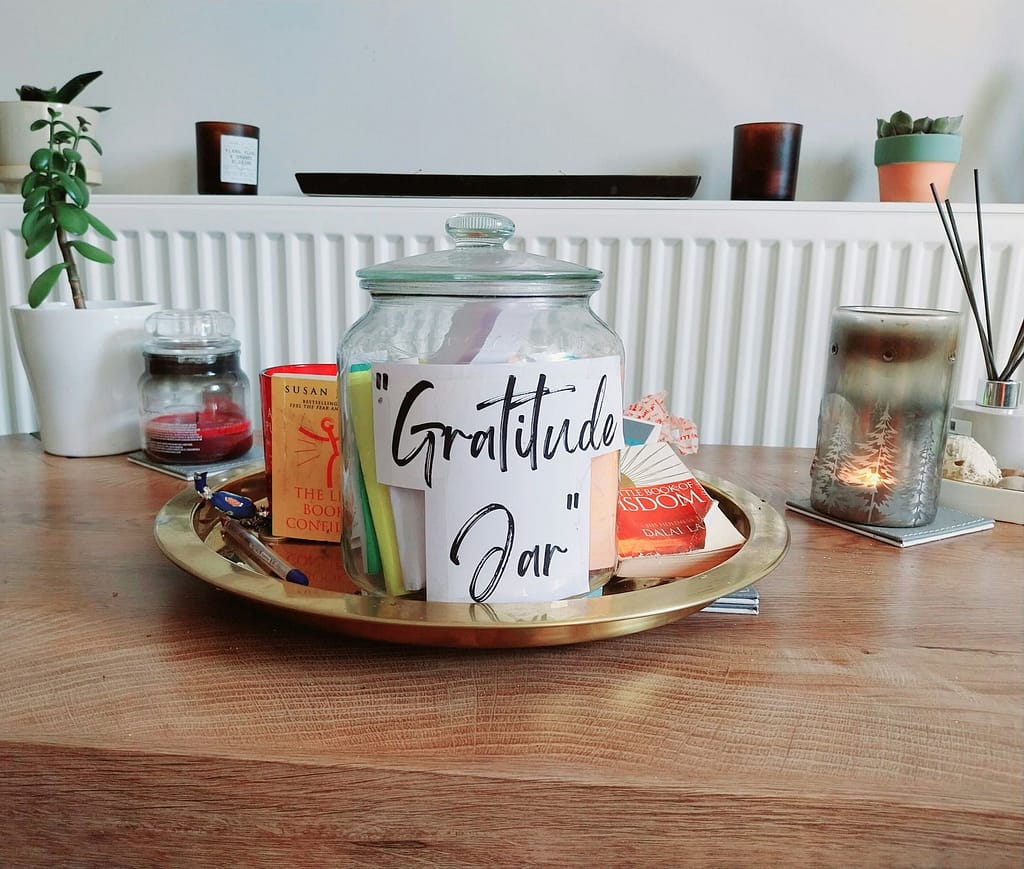
Photo by Mark Casey on Unsplash
Step 4 – Write From the Heart
Don’t worry about perfect grammar or phrasing; gratitude journaling is for you. Let your writing flow naturally. If you’re not sure where to start, use prompts like:
- “Today I felt grateful for…”
- “Someone who made my day easier was…”
- “A challenge I learned from this week is…”
Write honestly. The goal isn’t to perform gratitude, it’s to feel it. Some days you may find you can only list one thing, and that’s okay too. Sometimes when we’re in the midst of a storm, it becomes difficult to see beyond the chaos and feel appreciative of the sunlight that is still there; just distant. It may even feel challenging and unnatural at the start, but allow yourself the time to adjust and get comfortable with it.
Just like anything, practice is what will help you grow into it. What might help is building a small space that sets the ambience for your journaling session, this can help you feel calm and cozy on those days that may feel a little challenging. Whenever I feel uneasy, I like to light a vanilla-scented candle as it helps me ground in the moment.

Photo by Paolo Nicolello on Unsplash
Step 5 – Reflect and Revisit
After a few weeks, look back through your entries. You’ll notice how your perspective has shifted. Some days will be detailed and emotional; others may just list the basics. Both count.
Reflecting helps you see growth and reminds you that gratitude isn’t just an exercise, it’s a mindset that deepens over time. When you learn to express true gratitude, the Universe will give you more to be grateful for.
FAQ
How long should I spend journalling each day?
Just five minutes can make a difference. The goal isn’t the length, it’s the consistency. There is no right or wrong here.
What if I can’t think of anything to write?
Start small. Be grateful for basic things like your breath, your home, your body carrying you through the day. Gratitude grows with practice.
Can I do it digitally?
Absolutely. Digital journaling works just as well as pen and paper. What matters is your reflection, not the medium.
Do I need to write every day?
Daily is ideal, but even a few times a week can have an impact. It’s better to write occasionally than to stop entirely because you missed a day.
What’s Next?
Gratitude journaling is a simple act with long-lasting effects. Over time, it helps you build resilience, strengthen relationships, and find peace in the present. Once you’ve built this habit, explore ways to deepen your practice, like pairing it with meditation, reflection walks, or your nightly self-care routine.


Pingback: How to Gently Reconnect with Movement - (An Effective Guide for 2026) - rnworld
Pingback: Digital Connection vs. Real Connection 2025: Which Is Better for Your Well-Being? - rnworld