
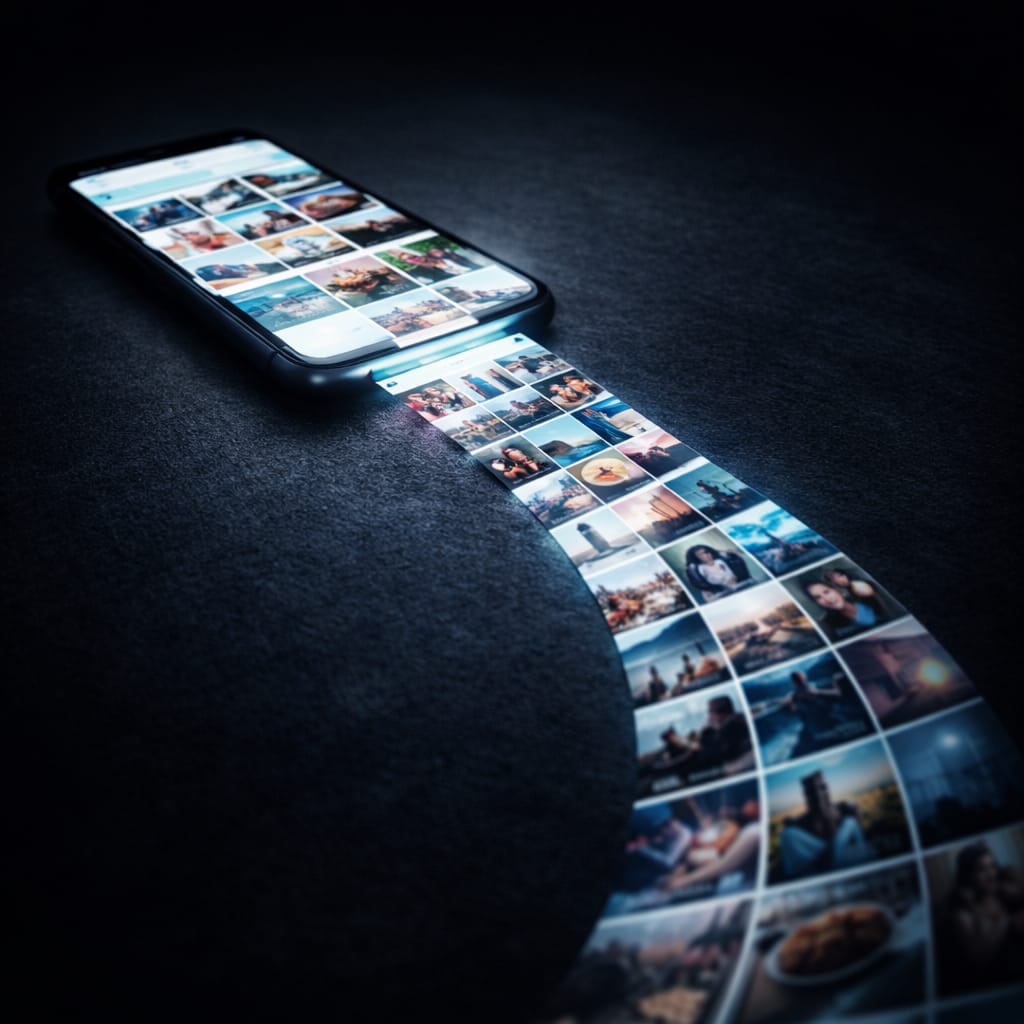
The conversation around social media vs real life has become impossible to ignore. Many of us wake up, check our phones, scroll through carefully curated lives, and before we’ve even taken a sip of coffee we feel subtly behind. Behind in success, behind in happiness, behind in purpose. The strange thing is that most of us intellectually know that what we see online is filtered, curated, edited, and algorithmically amplified. Yet emotionally, it still affects us.
The tension between social media vs real life is not simply about comparison anymore. It is about attention, empathy, distraction, and the way modern technology shapes how we process the world. Social media can connect us to ideas, movements, and communities we might never encounter otherwise. At the same time, it can fragment our attention, heighten outrage, and create a version of reality that is louder and more extreme than the world we actually live in.
This post is not about villainising social media. Many of us rely on it for community, information, creativity, and even moments of relief when life feels heavy. But if we want to understand the emotional landscape of modern life, we have to explore the tension between social media vs real life and how it subtly shapes the way we think, feel, and relate to each other.
Quick Comparison
When people talk about social media vs real life, they are often describing the gap between what we see online and what we experience offline.
In real life, most people are complex, nuanced, and contradictory. Conversations unfold slowly. Opinions change. People are capable of kindness and ignorance in the same breath.
On social media, however, reality becomes compressed into fragments designed to capture attention. The most dramatic moments rise to the surface while the quiet, ordinary experiences that make up most of human life disappear.
In simple terms:
- Real life is slow, imperfect, and nuanced.
- Social media is fast, performative, and amplified.
Neither is inherently good or bad, but understanding the difference between social media vs real life helps us navigate the emotional pressures that come from living between both worlds.
Table of Contents
Features
One of the defining features of social media vs real life is the way attention works within each environment. In real life, attention moves naturally. You focus on a conversation, a task, or a moment. There is space for boredom, reflection, and the gradual unfolding of thought.
Social media, on the other hand, is engineered to capture and hold attention for as long as possible, but because of the sheer volume of content, our attention spans struggle. Algorithms reward content that provokes strong reactions. This means that outrage, conflict, shock, and emotional extremes are more likely to spread than calm or nuance.
The design itself encourages certain behaviours:
- Infinite scrolling removes natural stopping points
- Notifications trigger quick dopamine responses
- Short-form content rewards rapid consumption rather than reflection
- Algorithms amplify content that keeps users engaged
When we compare social media vs real life through this lens, it becomes clear that the platforms are not neutral spaces. They are systems designed to compete for attention, and attention is one of the most valuable resources we have.
Over time, this can subtly reshape how we think. Many people notice that their ability to concentrate on longer tasks declines. Reading books feels harder. Quiet moments feel uncomfortable. The mind begins to expect constant stimulation.
This does not mean social media is inherently harmful, but it does mean that the structure of the platforms influences how our brains engage with information.
Impact
Many people recognise the tension between social media vs real life not through research but through their own experiences.
You might notice it when you open an app for a few minutes and suddenly an hour has passed. Or when you catch yourself comparing your ordinary afternoon to someone else’s highlight reel and feeling strangely inadequate even though you know the comparison is unfair.
Another moment where the gap between social media vs real life becomes clear is when you spend time with people offline. Conversations tend to be softer, slower, and less polarised than the debates you see online. Most people are not walking around in constant ideological battles.
In real life, someone can disagree with you and still share a meal with you. Online, disagreements often escalate quickly into hostility because the environment rewards conflict and performance.
There is also the emotional seesaw many people experience when consuming news and global events through social media. We can witness immense suffering, injustice, and tragedy within seconds. Our empathy is triggered instantly, but the constant exposure can also lead to emotional exhaustion.
This creates a strange pattern:
- Moments of intense empathy
- Followed by emotional numbness
- Followed by guilt for feeling numb
- Followed by another wave of distress
- Resulting in feeling ultimately powerless & trapped
The tension between social media vs real life becomes especially visible here. In real life, we encounter suffering in more contained ways. Online, the entire world’s tragedies can appear within minutes on the same screen where someone is posting holiday photos or brain-rot reels.
Our brains were never designed to process that level of emotional information simultaneously.
The Dopamine Loop
Another important element of social media vs real life is the role of dopamine. Dopamine is often described as the brain’s reward chemical. When we encounter something pleasurable or stimulating, dopamine reinforces the behaviour so that we are more likely to repeat it.
Social media platforms use this principle effectively. Every notification, like, comment, or new piece of content offers a small reward.
The cycle often looks like this:
- Open the app
- Receive new information or stimulation
- Experience a small dopamine response
- Repeat the behaviour
Individually these moments are small, but over time they create a habit loop that makes it difficult to disengage.
The contrast between social media vs real life becomes apparent when we look at the types of rewards each environment offers. Real life rewards are slower and require effort. Completing a project, building a skill, nurturing relationships, or improving health takes time. The rewards are meaningful but delayed and can heighten impatience.
Social media rewards are immediate and effortless. Within seconds you can experience novelty, validation, entertainment, or distraction. Because of this difference, many people find themselves gravitating toward quick digital rewards even when they know deeper satisfaction lies elsewhere.

Pros and Cons
The conversation around social media vs real life often becomes overly simplified. Some people frame social media as entirely harmful, while others see it purely as a tool for connection and expression.
The reality of social media vs real life is more complicated.
Some genuine benefits include:
- Access to diverse perspectives and global conversations
- Opportunities for creative expression
- The ability to find communities that may not exist locally
- Rapid sharing of information and resources
At the same time, there are real drawbacks that many users recognise. Some of the challenges of social media vs real life include:
- Constant comparison with curated images of other people’s lives
- Increased exposure to outrage and conflict
- Reduced attention span due to rapid content consumption
- Emotional exhaustion from witnessing global crises continuously
Acknowledging both sides allows us to have a more honest conversation about how to engage with these platforms without losing our sense of balance.
Alternatives
If the tension between social media vs real life feels overwhelming at times, the solution is not necessarily to abandon social media completely. For most people that is unrealistic. Social platforms are woven into modern communication, work, creativity, and community.
Instead of treating social media as something to eliminate, it can be helpful to think about how we relate to it. The difference between feeling consumed by it and using it intentionally often comes down to small shifts in awareness.
One approach is to become more conscious of when we are using social media as a tool versus when it becomes a reflex. Many people notice that they reach for their phone automatically during moments of boredom, discomfort, or uncertainty. The habit is not always about the content itself, but about the relief from whatever feeling existed before opening the app.
When we think about social media vs real life through this lens, the goal is not perfection but awareness. A few simple shifts can make a difference:
- Pausing before opening an app and asking why you are reaching for it
- Noticing how you feel before and after scrolling
- Limiting exposure to accounts that trigger constant comparison or outrage
- Making space for activities that require sustained attention
These small boundaries can help restore a sense of agency. Social media becomes something we use rather than something that quietly consumes the background of our day.
The Illusion of Constant Urgency
Another reason the tension between social media vs real life feels so intense is the sense of constant urgency that platforms create. Online, everything appears immediate. Every issue feels like the most important issue of the moment. Every conversation seems like it demands instant engagement or response.
But in real life, most meaningful change unfolds slowly. Relationships develop over years. Social movements grow through long-term effort. Personal growth happens through quiet repetition rather than viral moments.
The environment of social media compresses time. It creates the illusion that everything must happen quickly and that we must always be reacting. This constant urgency can leave people feeling like they are never doing enough.
Many users experience a subtle internal pressure where they have to: speak about every issue, stay informed at all times about every global event, and respond immediately to every new piece of information. The irony of this urgency is that we no longer stop to ask whether what we are consuming is factual or not.
Regardless, the human mind cannot sustain that level of engagement without fatigue. The tension between social media vs real life becomes clear when we step away from the screen and notice how much quieter the world actually can be.
Real life contains pauses, silence, and moments where nothing dramatic is happening. Those spaces are not emptiness. They are the conditions in which reflection and emotional recovery happen.

The Rise of Consumerism as Emotional Relief
One of the more subtle ways social media vs real life diverge is in how platforms influence consumer behaviour. Scroll through any social platform long enough and you will encounter an endless stream of products, trends, and objects presented as solutions to everyday feelings. The messaging is rarely explicit, but it is powerful.
Feeling bored? Buy something new.
Feeling stuck? Refresh your aesthetic.
Feeling unfulfilled? Upgrade your life.
Consumer culture has always existed, but social media accelerates its visibility. Trends can appear and spread across millions of people within days. The cycle of discovery, obsession, and replacement moves faster than ever.
Many people have experienced this through sudden viral product crazes. The excitement builds quickly. Everyone seems to want the same object at the same time. For a moment it feels like participating in the trend might offer a small sense of belonging or excitement.
The recent Labubu craze was a perfect example of this phenomenon. A small collectible figure became an online sensation almost overnight. People lined up for hours to buy it, shared photos, and participated in the collective excitement.
There is nothing inherently wrong with enjoying objects or trends. Humans have always used material culture as a way to express identity and connect with others. But the tension between social media vs real life becomes visible when we look at the emotional expectations attached to these purchases.
Consumerism often promises a form of relief. The idea that the right purchase might fill a vague emotional gap or bring a moment of excitement that cuts through the monotony of daily life.
For a brief moment, it can work. The anticipation of buying something new, the act of receiving it, the novelty of ownership. These moments create small spikes of pleasure.
But the relief is temporary.
Soon the excitement fades and the underlying feelings remain unchanged. The cycle begins again with the next product, the next trend, the next thing that promises a spark of novelty.
In this way, consumer culture sometimes acts as a substitute for deeper forms of fulfilment that take longer to build. The contrast between social media vs real life becomes clear again here.
Real fulfilment tends to grow from things that cannot be bought instantly:
- Meaningful relationships
- Creative work
- Learning new skills
- Physical experiences
- Moments of genuine connection
These forms of satisfaction develop slowly and require time, patience and effort. In a fast-paced digital environment, they can feel less visible than the constant stream of products promising quick excitement.
The Optimisation Industry
Another layer in the tension between social media vs real life is the rise of what could be called the optimisation industry.
Scroll through social media long enough and you will eventually encounter an endless stream of advice on how to improve yourself. Productivity systems promise to maximise your time. Morning routines claim to unlock your potential. Courses offer the blueprint for success, confidence, financial freedom, or healing.
Self-improvement is not inherently negative. Learning new skills, reflecting on habits, and growing as a person are all meaningful parts of life. But the way these ideas appear within social media ecosystems often transforms growth into something that feels compulsory.
Instead of encouragement, the message can begin to feel like pressure.
If you are not optimising your routine, you are falling behind.
If you are not building passive income, you are wasting time.
If you are not constantly improving yourself, you are failing.
Within the environment of social media vs real life, self-improvement becomes another product to consume.
Many creators genuinely want to help others, but the business model of social media often rewards a particular formula. A vulnerability is identified, the problem is magnified, and then a system or course is offered as the solution.
Feeling stuck becomes an opportunity to sell a life strategy.
Feeling lonely becomes an opportunity to sell a confidence or dating program.
Feeling overwhelmed becomes an opportunity to sell a productivity system.
Over time, life can start to feel like an endless project of optimisation. Instead of living, people feel like they are constantly upgrading themselves.
The irony is that real growth rarely follows neat systems or perfectly structured routines. It is slower, more uncertain, and often deeply unproductive from the outside. Healing, creativity, and personal development tend to unfold through messy experiences rather than perfectly optimised frameworks.
When we compare social media vs real life, this is one of the most striking differences. Online, transformation is presented as something quick, structured, and achievable if you simply follow the right formula. In real life, growth is usually far less linear.
Recognising this difference can be freeing. Not every part of life needs to be optimised, monetised, or turned into a system.
Sometimes the most meaningful parts of life are the ones that unfold without a strategy at all.
Division and the Comfort of Distance
Another dynamic that emerges in discussions of social media vs real life is the way online environments can intensify division between people. Behind a screen, it becomes easier to speak in ways we might never speak face to face. The absence of physical presence removes many of the subtle social cues that normally regulate conversation.
In real life, tone of voice, body language, and shared context influence how we communicate. Even when disagreements occur, the presence of another person often encourages a level of restraint.
Online, that restraint can disappear.
The result is a landscape where extreme opinions often receive the most attention. Algorithms reward engagement, and engagement frequently follows conflict. The more provocative a statement is, the more likely it is to spread.
Over time, this can create the impression that the world is filled with constant hostility. The tension between social media vs real life becomes evident again when we step away from the digital environment and interact with people directly.
Most everyday interactions are far less dramatic than the conversations unfolding online. Many people are capable of nuance, compromise, and kindness when they are not performing for an audience.
Recognising this difference can help reduce the feeling that society is permanently fractured. The loudest voices online are not always representative of the majority of people offline.
Reclaiming Attention and Humanity
If there is a thread connecting all of these experiences, it is attention. The conversation about social media vs real life ultimately comes back to how we choose to direct the limited attention we have each day.
Attention shapes what we notice, what we care about, and how we understand the world. When attention is constantly fragmented, our sense of clarity can fade.
Reclaiming attention does not require dramatic digital detoxes or abandoning technology entirely. Sometimes it begins with smaller practices.
Creating moments where attention is focused on a single experience can gradually restore a sense of balance. This might mean reading without interruptions, having conversations without checking notifications, or simply spending time in environments where nothing is competing for our focus.
These moments remind us that the depth of human experience still exists beyond the scroll of a screen.
The goal is not to reject social media but to recognise its limits. Platforms can connect us to ideas and communities, but they cannot replace the slower, richer texture of real life.
Conclusion: Navigating Social Media vs Real Life in 2026
The conversation about social media vs real life is not about choosing one world over the other. Both exist, and most of us move between them every day. Social media can inspire creativity, foster community, and spread valuable information. At the same time, it can amplify comparison, accelerate consumerism, fragment attention, and expose us to emotional stimuli that our minds struggle to process.
Understanding the difference between social media vs real life allows us to engage with these platforms more consciously. Instead of expecting social media to provide fulfilment, we can recognise it as one tool within a much larger landscape of human experience.
Real life remains the place where most meaningful things happen. It is where relationships deepen, where ideas evolve slowly, where growth unfolds in ways that cannot be condensed into a post or a video. The digital world will continue to shape how we communicate and perceive reality. But the quiet, imperfect, and deeply human world beyond the screen still holds the experiences that sustain us.
If you found this post insightful, you might also enjoy reading Digital Connection vs. Real Connection, which explores the nuances of connections online vs in real life.


Pingback: How to Do a Digital Detox in 2026 (Without Accidentally Isolating Yourself) - rnworld
Pingback: Who Are You Without Social Media? (Why Social Media Feels Fake in 2026) - rnworld