

If you’ve ever stood in front of your bathroom mirror wondering whether you need another product or another tool, you’re not alone. Skincare has become increasingly layered, and it’s easy to feel like you’re missing something essential if your routine isn’t packed with both. Tools promise efficiency, deeper results, and professional-level care at home. Products promise nourishment, repair, and visible change. Somewhere in the middle, most of us are just trying to take care of our skin without turning it into a full-time job.
The conversation around skincare tools vs skincare products often feels polarising, as if you have to pick a side. In reality, most people aren’t asking which category is better in theory. They’re asking what actually makes a difference in real life, especially when motivation fluctuates, energy is limited, or consistency is hard to maintain.
This post breaks down skincare tools vs skincare products in a grounded, practical way. Not from a place of hype or trends, but from lived experience, realistic routines, and what actually supports your skin long term. Whether you’re overwhelmed by options or trying to simplify, this comparison is meant to help you decide what’s worth your time, money, and effort in 2026.
This post may contain affiliate links. If you make a purchase through them, I may earn a small commission at no extra cost to you.
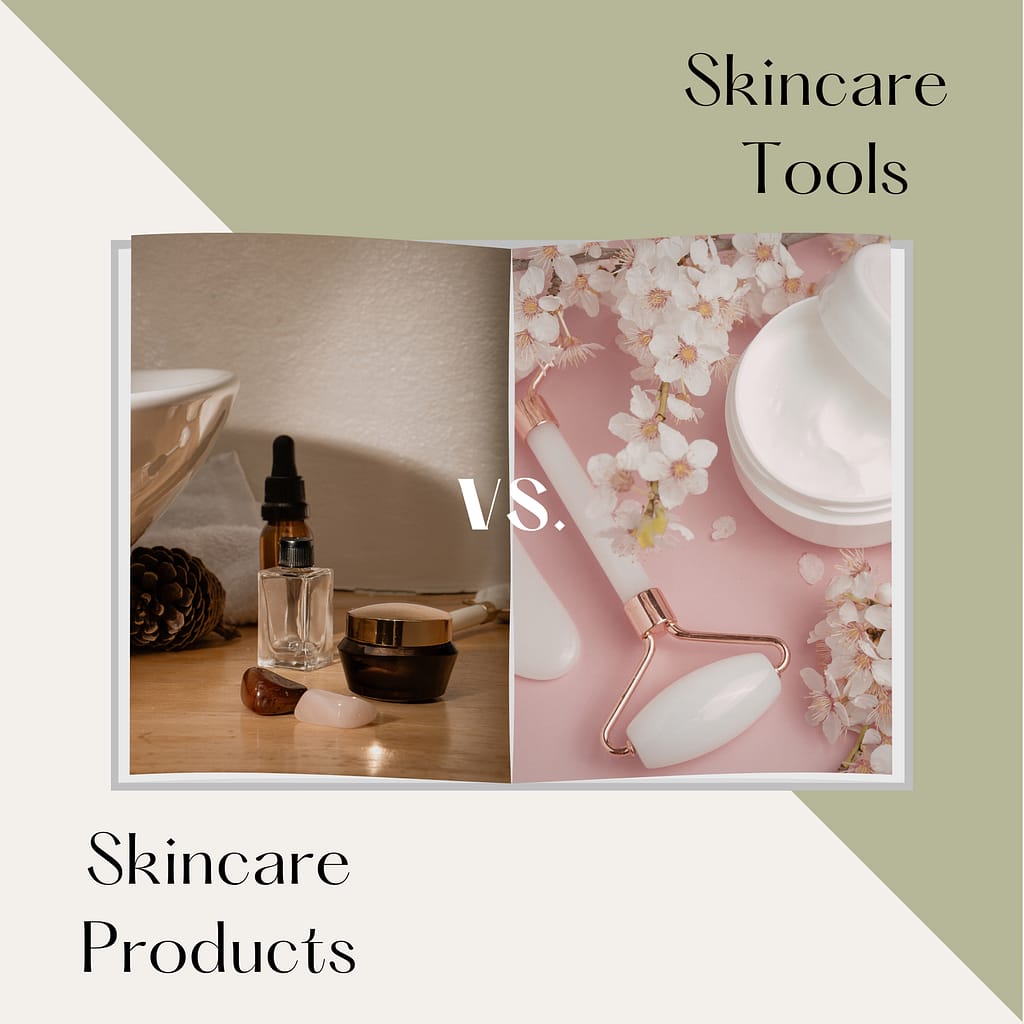
Table of Contents
Quick Comparison
If you don’t want to read the full breakdown, here’s the short answer. Skincare products do the heavy lifting when it comes to skin health, barrier repair, and long-term results. Skincare tools can enhance a routine, improve application, or support specific goals, but they’re rarely essential on their own. If you are having skin concerns, then adding a tool most likely won’t resolve this for you.
This is because, in the skincare tools vs skincare products debate, products generally have a more consistent impact, while tools work best as optional support rather than replacements. Think of products as the food you eat and the tools as the seasoning. You can still have the food without the seasoning, it’s just that the seasonings elevate the experience.
If you’re choosing between investing in a solid product routine or buying multiple tools, prioritising skincare products usually makes more sense. Tools can be helpful, but they’re most effective when paired with the right products and used consistently.
Features
When comparing skincare tools vs skincare products, the biggest difference lies in how they work. Skincare products interact directly with the skin’s surface and deeper layers. They’re formulated to cleanse, hydrate, exfoliate, protect, or treat specific concerns. Their effectiveness depends on ingredients, formulation, and how well they suit your skin type.
Skincare tools, on the other hand, are physical or mechanical aids. Their purpose is usually to enhance circulation, improve product absorption, assist with hair removal or exfoliation, or provide convenience. Tools don’t typically change the skin on their own; they change how products are applied or how the skin is stimulated.
Another key difference is adaptability. Skincare products can be rotated, layered, or adjusted as your skin changes. Tools tend to be more static. Once you own a tool, its function doesn’t change, even if your skin does. This matters when you’re thinking long-term and trying to build a routine that grows with you.
In terms of learning curve, products generally require understanding ingredients and usage frequency, while tools require correct technique and hygiene. In the skincare tools vs skincare products comparison, misuse of tools can sometimes do more harm than good, especially if pressure, frequency, or sanitation aren’t considered.
Personal Experience
From my own experience, skincare products have always been the foundation of my routine. When my skin barrier was compromised, no tool could fix that. What helped was simplifying products, choosing formulas that supported repair, and staying consistent even when results weren’t immediate.
I’m someone who struggles with dry and sensitive skin, and so I stick to the same base products (cleanser, moisturiser and sunscreen) and add in extra products or remove them depending on my skin’s needs. If you are struggling with a compromised barrier or irritation, drop to the basics to heal your skin. These are products I’ve personally used or researched extensively, and I’ve grouped them based on skin type to make choosing easier.
Cleanser Options:
- Vanicream Gentle Facial Cleanser – for dry, sensitive skin
- Cetaphil Gentle Exfoliating SA Cleanser – for combination-oily skin
Moisturiser Options:
- COSRX Propolis Light Cream – I use this in the day time as it’s lightweight but still provides me enough hydration. The only point I’d make here is that Propolis is not an ingredient that everyone can tolerate, so be sure to patch test if you buy this as you would with any new product.
- COSRX Honey Glow Propolis Cream – This is what I use at night, it’s a bit heavier compared to the day cream and I like the subtle glow it leaves on my skin.
- Vanicream Moisturizing Cream – If you find you need a heavy moisturiser for extra hydration, this is my best recommendation for you. I switch to this cream in the winter as my skin becomes extra dry and needs more support.
- La Roche-Posay Effaclar Mat Cream – Lightweight mattifying moisturiser for oily skin types, especially great if you struggle with excess sebum production.
Sunscreen Options:
- Relief Sun Aqua-Fresh – My holy grail sunscreen. It is technically for combination-oily skin types, but I find this works well for me because of the layering I do in my morning routine.
- Relief Sun : Rice + Probiotics – From the same line as the above, but a heavier formula, better suited for dry skin types.

If you were interested in seeing a deeper breakdown of base products, how they work and how to choose the best fit for you, then check out my beginner skincare guide on The Only 3 Essentials You Truly Need. Now onto skincare tools.
Skincare tools entered my routine later, after I had gone through the trials and tribulations of understanding my skin type, needs and finding the right products. Sometimes tools made the process feel more intentional or enjoyable. Other times, they became another thing I felt guilty for not using consistently. That’s something I don’t think gets talked about enough in the skincare tools vs skincare products conversation.
The one tool that I actually feel is a necessity (even though it technically isn’t but it elevated my cleansing experience), is a Silicone Facial Cleanser. They are inexpensive, so easy to use and hygienic if you clean them right. When it comes to skincare tools vs skincare products, your hands are enough to lather your cleanser and clean your face. I just find that the silicone cleanser gives me a deeper clean through subtle exfoliation.
Skincare tools aren’t essential in most cases, so if you’re ever told you must have a particular tool, that’s usually a sign you can safely do without it. They feel novel, tactile, and promising. But novelty fades. Products, especially the right ones, tend to integrate more seamlessly into daily habits. Washing your face and applying moisturiser is easier to maintain long term than remembering to charge, clean, and correctly use multiple devices.
That doesn’t mean tools are useless. It means they work best when they align with your lifestyle. If your routine already feels like a stretch, adding tools can create friction. If your routine is stable and you enjoy the process, tools can enhance it.
Pricing
Pricing is another area where skincare tools vs skincare products differ significantly. Skincare products usually involve ongoing costs. Cleansers, serums, and moisturisers need to be repurchased regularly. Over time, this adds up, but it also allows flexibility. You can adjust spending, try different price points, or swap products without committing long term. You actually don’t need to invest in overpriced products to achieve your ideal skin, you just need to understand the products you have, and how they can address your particular skin concerns/goals.
Skincare tools often come with a higher upfront cost. While some are affordable, others are positioned as investments. The appeal is that you buy them once and use them repeatedly. However, this only works if you actually use them. An expensive tool sitting unused is far more costly than a moderately priced product you rely on daily.
There’s also maintenance to consider. Tools may require replacement parts, batteries, or additional cleaning products. These hidden costs are often overlooked in the skincare tools vs skincare products discussion but can affect long-term value.
However, if you do invest in a tool, this is completely fine as well. Over time the uses you get out of it balances out the initial investment. What matters most is consistency here.
Pros & Cons
When weighing skincare tools vs skincare products, it helps to look at the strengths and limitations of each.
Skincare products are versatile, adaptable, and directly impact skin health. They’re supported by formulation science and can be tailored to specific concerns. Their biggest downside is that results take time, and trial and error can be frustrating. There are also so many products on the shelf today, that it’s easy to get confused, overwhelmed and drawn to marketing gimmicks, especially if you are new to skincare.
Take all skincare advice with a grain of salt (yes, even mine), because at the end of the day, everyone’s skin responds differently, even when skin types appear similar. What works beautifully for one person may do very little for another. I tested countless options, including mineral sunscreens that many people swear by, and none of them suited my skin.
That process taught me that there’s no shortcut around getting to know your own skin. Choosing the right products takes time, patience, and a willingness to experiment without assuming something isn’t “working” because you’re doing something wrong.
Skincare tools can be genuinely helpful when used intentionally. They can improve how products are applied, encourage more even distribution, and in some cases tools like face rollers can support circulation or lymphatic movement. For some people, tools also make a routine feel more engaging or enjoyable, which can increase consistency.
At the same time, tools come with clear limitations. They require correct technique, regular cleaning, and consistency to be effective, which isn’t always realistic. It’s also easy to misuse tools by applying too much pressure, using them too frequently, or expecting results they simply aren’t designed to deliver.
Marketing often exaggerates what tools can do, creating the impression that they can replace a solid product routine. In reality, without the right products underneath, tools rarely create meaningful or lasting change, they tend to alter how the routine feels more than how the skin actually responds.
In the skincare tools vs skincare products debate, the biggest pro of products is reliability. The biggest pro of tools is enhancement. The biggest con of products is patience. The biggest con of tools is dependency on correct use and consistency.
Photo by Edz Norton on Unsplash
Alternatives
When the conversation around skincare tools vs skincare products feels overly binary, it’s often because people assume the only options are either investing heavily in tools or relying entirely on products. In reality, there are middle-ground approaches that sit comfortably between skincare tools vs skincare products and support skin health without committing fully to either extreme.
One alternative is prioritising multipurpose skincare products. Products that cleanse and hydrate, treat and protect, or soothe and strengthen the barrier reduce the perceived need for additional tools. In the skincare tools vs skincare products discussion, this approach works particularly well for people who struggle with consistency or decision fatigue.
Another alternative is focusing on technique rather than tools. How you apply products can matter just as much as what you apply. Taking the time to apply products evenly and intentionally often delivers more benefit than introducing another device. Some products also absorb better if you pat them in rather than rubbing them in. In skincare tools vs skincare products comparisons, technique is frequently overlooked, even though it costs nothing and integrates seamlessly into existing routines.
Professional treatments are sometimes mentioned as an alternative as well. While they can be effective, they are not always accessible or sustainable. For most people, a thoughtful at-home routine remains the foundation, regardless of where they land on skincare tools vs skincare products.
Effort and Consistency
Effort is one of the most important and least discussed factors when weighing skincare tools vs skincare products. A routine is only effective if it can be maintained over time. Skincare products tend to win here because they fit more naturally into daily life. Cleansing and applying products usually requires less setup than using tools correctly and safely.
Consistency often declines as effort increases. Many tools require charging, cleaning, or precise technique, which can unintentionally create barriers. In the skincare tools vs skincare products comparison, this is where products often feel more sustainable, particularly for people with fluctuating energy or busy schedules. However, products can also become counterintuitive if you overcomplicate your routine too (think 10+ step routines everyday).
Skincare products can allow for partial effort. On low-energy days, you can still cleanse and moisturise. With tools, it’s often all or nothing. This distinction plays a significant role in long-term outcomes when evaluating skincare tools vs skincare products.
Skin Concerns and Results
Different skin concerns respond differently within the skincare tools vs skincare products conversation. Concerns such as dryness, sensitivity, acne, hyperpigmentation, and barrier damage almost always require targeted skincare products. These issues are driven by internal skin processes that tools alone cannot address.
Skincare tools may support, but rarely resolve underlying concerns. This is why many people feel disappointed after investing in tools without seeing meaningful change. That’s why it’s important to take a holistic approach when choosing between skincare tools vs skincare products.
Lifestyle Fit
Lifestyle fit often becomes the deciding factor in skincare tools vs skincare products. A routine that looks ideal on paper may not work in practice, and sustainability matters more than intention.
If you enjoy ritual, have time in the evenings, and find tactile experiences motivating, skincare tools may add value to your routine. If you’re frequently tired, busy, or overwhelmed, skincare products that work quietly in the background are usually the better choice. In skincare tools vs skincare products decisions, lifestyle compatibility often outweighs theoretical effectiveness.
Emotional bandwidth also matters. Skincare should not become another area where you feel behind or inadequate. If tools create pressure or guilt when unused, they may not be serving you, regardless of where they sit in the skincare tools vs skincare products hierarchy.
Conclusion: Who Is the Winner?
So, in the skincare tools vs skincare products comparison, what actually makes the biggest difference?
For most people, skincare products come out on top. They directly affect skin health, are easier to integrate into daily life, and deliver more consistent results over time. They form the foundation of any effective routine.
Skincare tools are not unnecessary, but they are supplementary. In skincare tools vs skincare products decisions, tools work best when a product routine is already established and when the tool fits naturally into your lifestyle. They can enhance or support a routine, but they rarely replace the need for well-formulated products.
If you’re deciding where to invest your time and money in 2026, prioritising skincare products is usually the more reliable choice. Tools can be added thoughtfully and intentionally, rather than as a solution to fix what products haven’t addressed.
Ultimately, the skincare tools vs skincare products debate isn’t about choosing sides. It’s about choosing what you can maintain without pressure, guilt, or burnout; because consistency, self-awareness, and sustainability are what make the real difference.
Disclaimer
I’m not a dermatologist, esthetician, or medical professional. These recommendations are based on my personal experience and further research. Always patch test new products and consult a professional for personalised advice.


