

A lot of people slow down and then immediately start panicking, not because slowing down is wrong, but because they can’t tell what’s happening inside them.
They stop doing things and feel foggier instead of clearer. Or they stop and feel heavy but more present. Or they stop and feel nothing at all. And then the question kicks in:
Is this rest, or am I avoiding something?
That question is the entire reason people search avoidance vs rest. Not because they want permission to rest, and not because they want advice. They want orientation. They want to know what state they’re actually in, without having to interrogate themselves or turn it into a moral judgement.
From the outside, avoidance and rest often look identical. From the inside, they don’t. The problem is that most people were never taught how to read the internal signals that distinguish one from the other.
This post is not about what you should do.
It’s about how to tell what is already happening inside of you.
Quick Comparison
If you strip avoidance vs rest down to their most basic internal effects, the difference is simple — but not obvious.
Avoidance reduces sensation.
Rest restores capacity.
Avoidance narrows your internal world.
Rest widens it.
Avoidance makes time disappear.
Rest keeps you oriented to time, even when you’re slow.
Avoidance often feels relieving first and agitating later.
Rest can feel uncomfortable first and settling later.
Time behaves differently in each state. In avoidance, time often collapses. Hours disappear without texture. You look up and feel disoriented, as if you were absent in your own life. In rest, time doesn’t necessarily move quickly, but it remains legible. You know where you are in the day. You feel the passage instead of losing it.
The emotional arc matters too. Avoidance often feels relieving at first, like exhaling after holding your breath; but that relief is temporary. As the numbness wears off, agitation or anxiety creeps in, especially at the thought of re-engaging. Rest can feel uncomfortable at the beginning because it removes the numbing layer, but over time it tends to settle the system rather than destabilise it.
These aren’t rules. They’re patterns. And they’re only noticeable if you stop trying to evaluate your behaviour and start paying attention to what follows it.
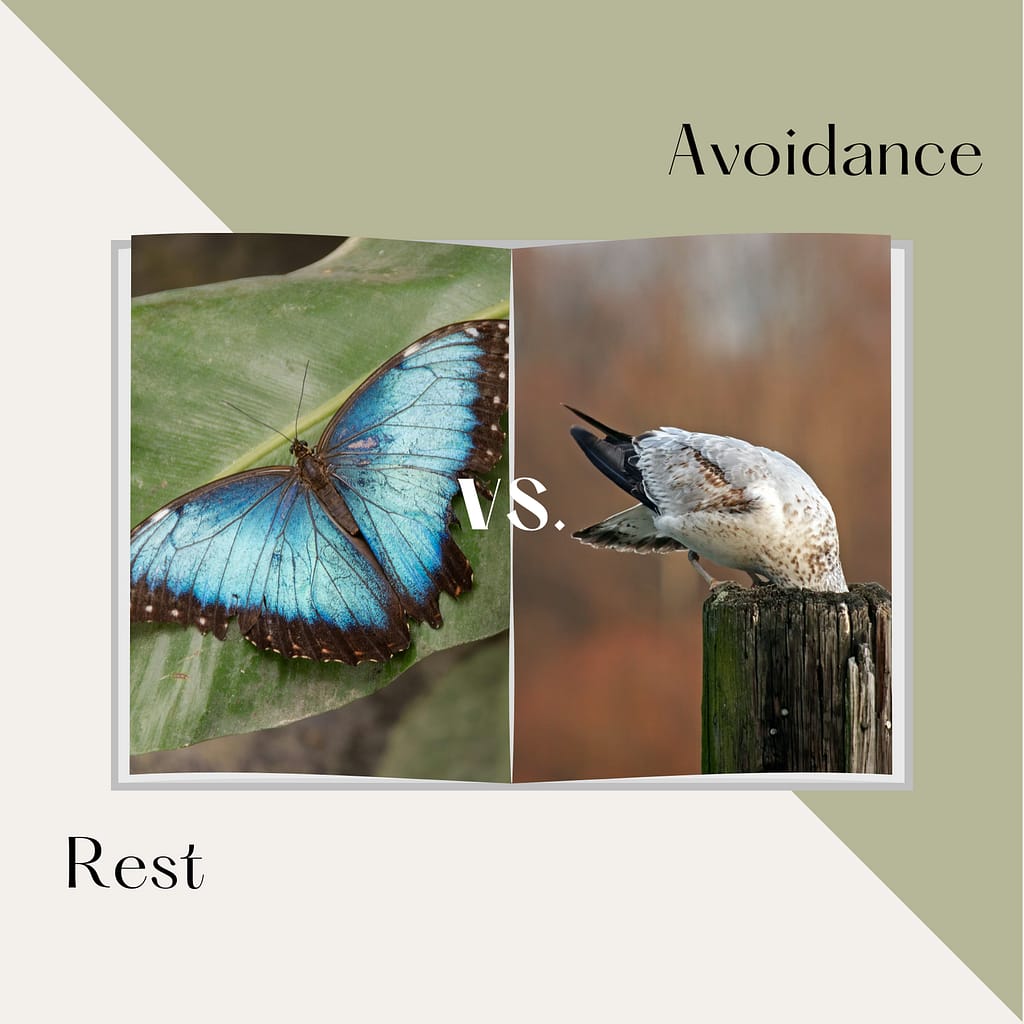
Table of Contents
Features
The easiest way to distinguish avoidance vs rest is to look at what each state does to your internal experience over time.
Avoidance works by dampening. It lowers emotional intensity, bodily sensation, and awareness. This can feel like numbness, zoning out, dissociation, compulsive distraction, or a heavy stillness that doesn’t quite feel restful. The key feature of avoidance is that it pulls you away from contact: with feelings, with desire, with decision-making, with yourself.
Rest does something different. It doesn’t remove sensation; it creates enough safety for sensation to be tolerated. You might still feel tired, sad, flat, or raw, but you’re present for it. You’re in your body. You can notice preferences, even small ones. Rest tends to reconnect you to choice, not eliminate it.
This is why avoidance vs rest can’t be distinguished by activities. Lying down can be either. Cancelling plans can be either. Watching something mindless can be either. The difference shows up in your internal signal strength.
Most people misread avoidance vs rest because avoidance often arrives wearing the costume of rest.
It looks like doing nothing. It feels like relief at first. And if you’ve been chronically overwhelmed, that relief can feel like the first quiet you’ve had in months.
The difference only becomes obvious later.
Avoidance has a particular aftertaste. It leaves you feeling smaller. Less connected to your own wants. Less able to imagine re-entry. You might think, “I should feel better by now,” or “Why do I feel worse after stopping?”
Learning to tell avoidance vs rest apart isn’t about catching yourself in the moment. It’s about noticing the pattern you return to.
After avoidance, people often report:
- Increased fog or disorientation
- Difficulty re-engaging
- A sense of time having vanished
- Low-grade anxiety about “getting back to life”
After rest, people often report:
- Clearer emotional signals, even if unpleasant
- A stronger sense of being “here”
- Slightly more access to preference or intention
- Fatigue with edges, not numbness
You don’t have to feel good for it to be rest. You do usually feel more real.
Personal Experience
It’s honestly hard to catch the pattern in real time. Differentiating between avoidance vs rest can feel almost impossible, especially when you’ve lived in one state for so long that it feels normal. Even when you start noticing the signs, there’s still the quieter fear underneath: what if I think I’m changing, but I’m not? What if I’m calling it rest when I’m actually just finding new ways to disappear?
That was something I struggled with for years. In my own experience with avoidance vs rest, I wasn’t consciously lying to myself, I was convincing myself. I wanted to believe I was resting because the alternative felt too confronting. I’ve lived with depression for most of my life, and when presence itself feels heavy, disengagement can start to feel like relief. Paralysis becomes familiar. You want to show up, but your body doesn’t seem to follow.
When I was in avoidance, the signs were subtle at first and then impossible to ignore. I struggled to remember small details. Guilt became a constant background noise. I had a persistent sense that my life was moving forward without me, that I was watching it happen from a distance no matter how much I wanted to step in. There was a period where I would sit in front of the TV for hours, not really watching, not really resting, just staring. Then suddenly it would be night, and I wouldn’t be able to account for the day at all.
This kind of avoidance is closely tied to disconnection, and sometimes to dissociation. And when you start to realise that’s what’s been happening, it can be genuinely frightening. There’s a particular kind of grief that comes with recognising you’ve been a passenger in your own life; wanting to take the wheel, but not knowing how to reconnect with the part of you that knows where you’re going.
In my own struggle with avoidance vs rest, there wasn’t a single switch that flipped. There were a lot of things I had to confront slowly, and one of the biggest was screen time. Doomscrolling wasn’t just a habit for me, it was fuel for avoidance. Days would pass without structure, without contact, without anything anchoring me to the present moment. At the same time, I was deeply absorbed in my past, replaying old pain, old stories, old wounds, which made the present feel even harder to inhabit.
For me, therapy was necessary. Not as a quick fix, and not as a dramatic turning point, but as something steady and long-term. It took years. And honestly, I’ve only recently started to experience what reconnection feels like. The difference now is that I can tell when I’m in avoidance vs rest because my awareness shifts. I notice my surroundings. I feel more agency. I feel like I’m here, even if I’m tired or emotional.
What helped wasn’t forcing myself to be productive, it was finding ways to engage my senses again. I needed activities that required presence, not performance. Things that gently pulled me back into my body. For me, those have been Jiu Jitsu, belly dancing, blog posting, and sewing. They ground me because they ask something of my attention without overwhelming me. They give shape to time through a routine. They remind me that I exist in the moment, not just in my head.
That’s when avoidance vs rest became easier to distinguish, not because I perfected it, but because I stopped disappearing from myself.
The Psychology Behind Self-Sabotage Through Avoidance
One of the most misunderstood aspects of avoidance vs rest is how personal it feels when avoidance keeps winning out. When you genuinely want change but keep finding yourself slipping back into old patterns, it’s easy to assume you’re self-sabotaging on purpose, that you don’t want healing badly enough, or that rest is just an excuse you’re hiding behind.
But avoidance vs rest is not a willpower issue. It’s a nervous system issue.
Avoidance is not the absence of desire for change; it’s what happens when your brain prioritises familiarity over uncertainty. Even when a pattern is painful, if it’s predictable, your system treats it as safer than the unknown. This is why, in the context of avoidance vs rest, rest can feel threatening rather than relieving; because rest often brings you closer to yourself, and closeness requires exposure.
Your brain is wired to preserve what it recognises. If you’ve spent years in survival mode, avoidance becomes the baseline. Disconnection, numbness, or paralysis stop feeling like red flags and start feeling normal. When that happens, shifting from avoidance vs rest isn’t experienced as progress, it’s experienced as danger.
This is why positive change can provoke anxiety even when you know it’s the better option. Choosing rest over avoidance means choosing presence over protection, and presence asks more of you. From a nervous system perspective, that anxiety isn’t a sign that something is wrong. It’s often a sign that you’re stepping outside a well-worn pattern.
This is also where people get stuck misreading avoidance vs rest as a moral failure. They hear phrases like “the power is yours” and feel disconnected from them, not because the power isn’t there, but because it feels inaccessible. Power, when you’ve lived in avoidance for a long time, doesn’t feel empowering, it feels non-existent.
In avoidance vs rest, power is actually often dormant, and that dormancy matters. Wanting change isn’t enough if your system hasn’t learned that change can be safe. Avoidance persists not because you’re weak, but because it once worked. It kept you functional. It kept you protected. It kept you alive in situations where rest or presence might have been too much.
This is why self-sabotage through avoidance is such a misleading label. What looks like sabotage is often a system trying to maintain equilibrium. The brain doesn’t differentiate between harmful familiarity and healthy novelty, it only recognises what it knows.
As you start to move from avoidance vs rest toward greater presence, anxiety often increases before it decreases. That anxiety isn’t evidence that you should turn back. It’s the nervous system recalibrating. It’s what happens when old protections are no longer needed, but new ones haven’t fully formed yet.
Rewiring avoidance vs rest doesn’t happen through force or self-criticism. It happens through repetition, safety, and gradual proof. Each time you choose presence and survive it, your system updates its expectations. Over time, rest stops feeling like a threat, and avoidance stops being the default.
I wanted to leave a note for you:
Avoidance doesn’t make you lazy.
Avoidance doesn’t make you broken.
Avoidance doesn’t mean you don’t want your life.
If you’re reading this and recognising yourself, it might feel heavy. It can feel lonely to realise how long you’ve been operating this way, and how far behind you believe you are. You might feel like everyone else learned how to live while you were stuck managing yourself.
But avoidance doesn’t mean you didn’t care. It doesn’t mean you didn’t want change. It means your system was doing what it knew how to do with what it had.
Wanting to show up is already evidence of something intact in you. Even if you can’t feel your agency clearly yet, it isn’t gone. It’s been quiet. Dormant. Waiting for enough safety to come back online.
You don’t have to believe that fully for it to be true. You just have to stop using your exhaustion as evidence against yourself.
The Costs
In avoidance vs rest, both have costs. The difference is when you pay them.
Avoidance is cheap upfront. It asks very little of you immediately. You don’t have to feel. You don’t have to decide. You don’t have to tolerate uncertainty. The cost shows up later: as prolonged stuckness, emotional flattening, or a growing fear of engagement.
Rest costs more upfront. It often requires tolerating sensation, emotion, or slowness without numbing out. You might feel exposed. You might feel unproductive. But the cost doesn’t compound in the same way. Over time, rest tends to return capacity instead of draining it. If you do struggle with allowing yourself to rest, I delve deeper into how to unlearn rest as unproductive in my post How to Give Yourself Permission to Rest.
This is why avoidance vs rest isn’t about right or wrong. Sometimes avoidance is the only thing available when capacity is too low. The problem isn’t avoidance itself, it’s mistaking it for rest long-term.

Photo by Gabrielle Taylor on Unsplash
Pros & Cons
Avoidance has real benefits. It protects you when things are too much. It can keep you functional during periods where engagement would overwhelm your system. It’s not a flaw; it’s a survival response.
The downside is that avoidance doesn’t restore. It stabilises by constricting. Over time, that constriction becomes the very thing people feel trapped inside. It’s also hard to tell when it starts taking over permanently.
Rest’s benefit is restoration. It rebuilds tolerance, not by pushing, but by allowing. The downside is that rest doesn’t numb. If you’re not resourced, it can feel confronting. That doesn’t mean it’s wrong, it means your system isn’t used to being with itself without distraction.
In avoidance vs rest, neither state makes you broken. One just leads back to yourself more reliably.
Alternatives
Sometimes the answer isn’t avoidance or rest, it’s regulation.
If your system swings between collapse and overdrive, pure stillness might tip you into avoidance, and pure engagement might overwhelm you. In those cases, regulated movement, gentle structure, or co-regulation with others can bridge the gap.
Avoidance vs rest is not a binary you’re meant to master. It’s a spectrum you learn to read.
There are many moments where avoidance vs rest isn’t the most useful framework at all.
Sometimes what you need isn’t withdrawal or stillness, it’s containment.
This might look like:
- Gentle structure that doesn’t demand performance
- Regulated movement instead of complete stillness
- Low-stakes engagement with others
- Predictable routines that reduce decision fatigue
If full rest tips you into numbness, and full engagement overwhelms you, the middle ground matters.
This is especially important for people whose nervous systems default to freeze. For them, “rest” without regulation can slide straight into avoidance. Not because rest is wrong, but because stillness without safety can feel like disappearance.
In those cases, alternatives to pure rest might include:
- Walking instead of lying down
- Doing something repetitive with light focus
- Being near others without interacting much
- Resting with sensory input instead of total withdrawal
Avoidance vs rest is not about doing nothing versus doing something. It’s about whether what you’re doing helps you stay connected to yourself.
The Internal Questions That Actually Help You Tell the Difference
If you’re trying to distinguish avoidance vs rest in real time, the mistake most people make is asking judgment-based questions.
Am I being lazy?
Am I doing enough?
Should I push through this?
Those questions don’t orient you. They interrogate you. And interrogation pushes people further into shutdown.
The questions that actually help are quieter and more somatic. They’re not about behaviour. They’re about state.
After this period of slowing down:
- Do I feel more present in my body, or less?
- Do I feel more capable of responding, or more resistant to everything?
- Is there more signal, even if it’s uncomfortable, or less signal altogether?
In avoidance vs rest, the signal matters more than the comfort.
Avoidance often lowers signal to survive. Rest often increases signal because there’s finally room for it. That’s why rest can feel heavier at first, you’re not being numbed anymore.
If you notice that after stopping, you feel foggy, detached, and vaguely anxious about re-engaging, that’s useful information. Not damning information. Just information.
If you notice that after stopping, you feel tired but more anchored, more emotionally available, or more aware of your own needs, that’s also information.
You’re not looking for a verdict. You’re building literacy.
Why Burnout Blurs Avoidance vs Rest
One of the reasons people get stuck in the avoidance vs rest question is prolonged burnout.
Burnout flattens internal contrast. Everything feels tiring. Everything feels effortful. Everything feels vaguely wrong. In that state, even real rest might not feel restorative, not because it’s avoidance, but because your system is deeply depleted.
This is where people panic and assume they’re doing something wrong.
But burnout doesn’t resolve with one nap, one weekend, or one pause. When capacity has been drained over a long period, rest restores in layers. The first layer often just reveals how tired you actually are. If you want to learn more about burnout, how to identify the signs and how to work to replenish your energy, then you might like my post How to Overcome Work Burnout. Whilst is focuses on a work context, the tips remain universal.
Burnout can look like:
- Needing far more rest than feels reasonable
- Feeling emotionally dull before feeling anything else
- Mistaking exhaustion for avoidance
In burnout, avoidance vs rest becomes harder to distinguish because both states can feel similarly flat. The difference shows up slowly, not immediately.
Avoidance keeps you flat.
Rest eventually gives the flatness edges.

Photo by Maddi Bazzocco on Unsplash
Avoidance Is Not a Moral Failure
This needs to be said clearly, without caveats.
Avoidance does not make you weak.
Avoidance does not mean you’re sabotaging yourself.
Avoidance does not mean you’re “not doing the work.”
Avoidance is what happens when your system decides that engagement costs more than it can afford.
Most people learned avoidance early. They learned it in environments where expressing needs wasn’t safe, where slowing down wasn’t allowed, or where staying alert was necessary. Avoidance kept them intact. It worked.
So when people feel ashamed for avoiding, they’re shaming a survival strategy that once made sense.
In avoidance vs rest, the problem isn’t avoidance itself. The problem is when avoidance becomes the only state available, and when people judge themselves instead of noticing what their system is communicating.
You don’t stop avoiding by shaming avoidance.
You stop avoiding by increasing safety.
Why People Keep Misreading One for the Other
People misread avoidance vs rest because they’re taught to evaluate outcomes instead of states.
If you don’t feel better, you assume you avoided.
If you feel better, you assume you rested.
But that logic doesn’t hold up.
Rest doesn’t always produce immediate relief. Sometimes it produces clarity. Sometimes it produces emotion. Sometimes it produces grief. None of that means it failed.
Avoidance, on the other hand, can feel relieving for a long time, until it doesn’t. The relief is not evidence of restoration.
This is why time matters. Avoidance vs rest reveals itself across patterns, not moments.
If you look back over weeks or months and notice that slowing down consistently leaves you feeling more disconnected from yourself, that’s worth paying attention to. Not to judge; to understand.
If you notice that slowing down eventually brings you back into contact with your needs, even when it’s uncomfortable, that’s also worth noticing.
The Orientation That Replaces Self-Policing
The goal of understanding avoidance vs rest is not to correct yourself. It’s to stop mistrusting yourself.
Instead of asking:
“Was that avoidance or rest?”
Try asking:
“What did my system need in that moment?”
And then:
“Did that give me more or less capacity over time?”
These questions don’t accuse. They orient.
Sometimes the answer will be: “I avoided because that’s all I had.”
Sometimes the answer will be: “I rested, even though it didn’t feel good.”
Sometimes the answer will be: “I needed something else entirely.”
None of those answers make you wrong.
Conclusion
Avoidance vs rest is not a test you pass or fail. It’s a distinction you learn to feel. Avoidance reduces contact to survive.
Rest increases capacity to live. Both exist for a reason. Both have a place. And neither defines your worth or your commitment to healing. If you’ve been stuck asking this question, it’s not because you’re doing something wrong. It’s because you’re paying attention and learning how to listen without turning awareness into punishment.
That’s not failure.
That’s literacy.
And literacy grows slowly, gently, over time.
Disclaimer
I am not a mental health professional, and this post is not a substitute for professional care or diagnosis. The reflections and suggestions shared here are intended as gentle methods to support your well-being and not to replace therapy, medication, or medical advice. If you are struggling or in distress, please reach out to a qualified professional or trusted service.


